Posts

Showing posts with the label electronic device

Touchscreen technology
Image
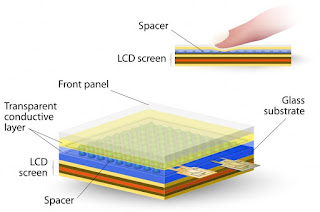
Touchscreen technology is the direct manipulation type gesture-based technology. A touchscreen is a source of input device and output device normally layered on the top of an electronic visual display of an information processing system.  As the name suggests touchscreen you have to touch the screen for any processing. It is sensitive to the touch of a human finger, hand, pointed figure nail and passive objects like a stylus. The user simply moves things on the screen, scroll them, make them bigger and much more. History The first ever touchscreen was developed by E. A. Johnson at the Royal radar establishment, Malvern, UK in late 1965. evidently, the first touchscreen was a capacitive type; the one widely used in smart phones now days. In 1971, a milestone in touchscreen technology was developed by doctor Sam Hurst, an instructor at the University of Kentucky research foundation. It was a touch sensor named ‘Elograph’. Later in 1974, Hurst in association with compan...
Memristor

Image
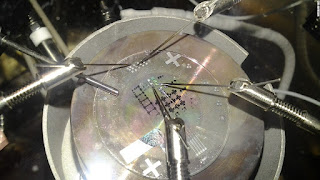
In recent year there has been a revolution in electronics, with a variety of phenomena being utilized in the construction of a new type of memory circuit for the computer application. A device which has had an increasing role is the memristor, whose description and properties have so far had little mention in physics education.  History  The memristor was the term coined in 1971 by  Leon Chua as a missing non-linear passive two-terminal electrical component relating electric charge and magnetic flux linkage. Leon Chua, a professor of electrical engineering at the University of California, Berkeley, predicted the existence of a fourth fundamental device, which he called a memristor. He proved that memristor behaviour could not be duplicated by any circuit built using only the other three elements, which is why the memristor is truly fundamental. Memristor is a contraction of ―memory resistor, because that is exactly its function: to remember its h...

Paper Battery

Image
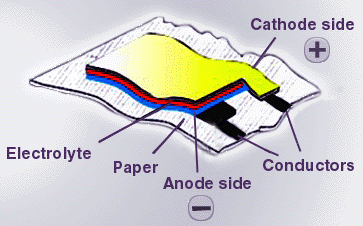
Paper Battery A paper battery is a flexible, ultra-thin energy storage and production device formed by combining carbon nanotube with a conventional sheet of cellulose-based paper. These batteries are environmentally-friendly. They are non-corrosive and not require extensive housing. A paper battery acts as both a high-energy battery and super capacitor combining two components that are separated in traditional electronics. This combination allows the battery to provide long-term steady power production and bursts of energy. Non-toxic, flexible paper batteries have the potential to power the next generation of electronics, medical devices, and hybrid vehicles, allowing for radical new designs and medical technologies. Features of paper battery Paper thin sheet,  like shape and size and allowing the storage device to conduct electricity. Function as both a lithium-ion battery and super capacitor; can provide a long, steady power output comparable to a c...